
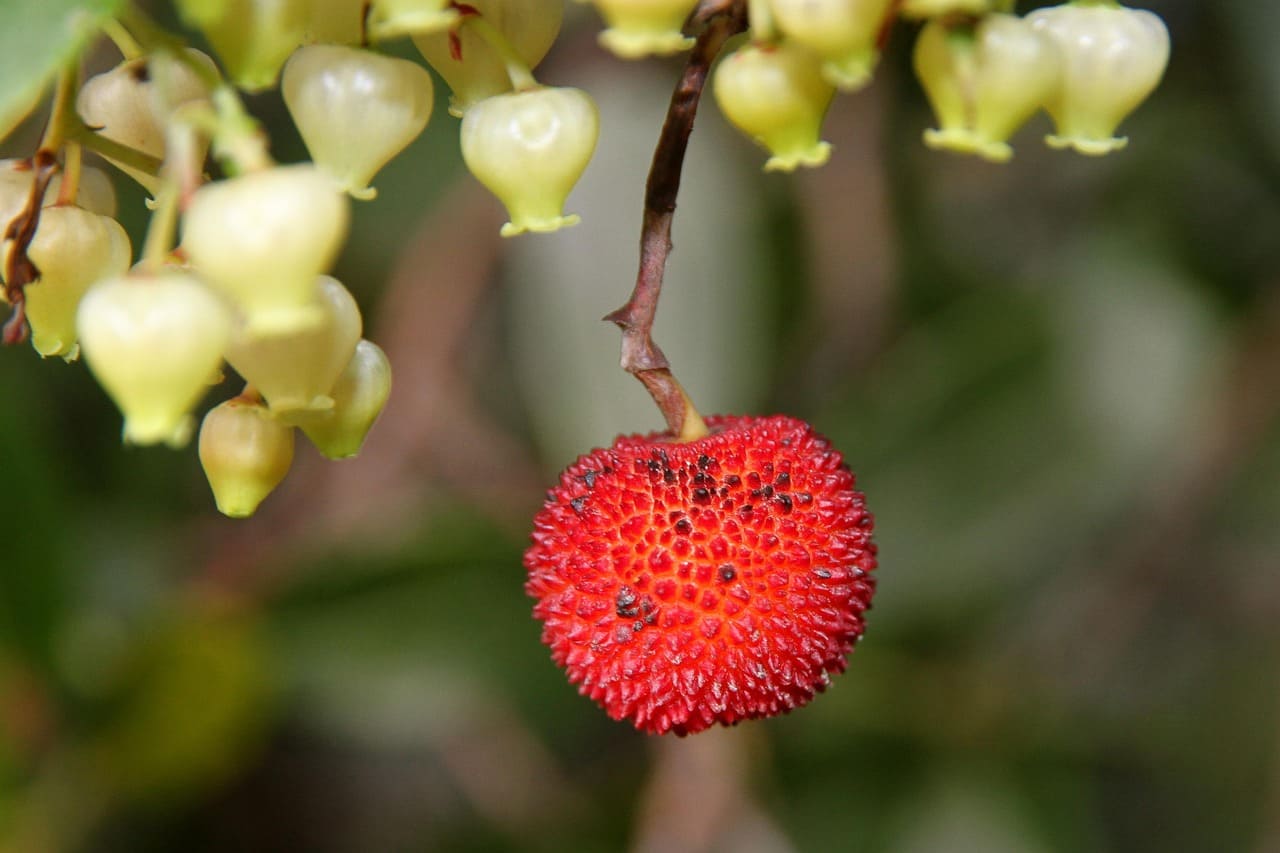
When most people think of strawberries, they imagine low-growing plants covered with tiny red fruits. But there’s another “strawberry” in the plant world — one that grows on a tree rather than a vine. Meet the strawberry tree, or Arbutus unedo, a stunning and versatile evergreen that brings color, texture, and even edible fruit to gardens across the globe. Known for its glossy green leaves, delicate white flowers, and bright red fruit, the Arbutus unedo strawberry tree is as beautiful as it is resilient.
Native to the Mediterranean region and parts of Western Europe, the strawberry tree has long been celebrated for its ornamental beauty and cultural significance. Sometimes referred to as the Irish strawberry, this tree has been a favorite in Irish gardens for centuries, particularly because of its ability to thrive in cool, damp climates. Its Latin name, Arbutus unedo, roughly translates to “I eat one,” a humorous nod from ancient botanists who found the fruit pleasant but not particularly sweet — though modern gardeners often appreciate its subtle flavor and unique charm.
The fruit of the strawberry tree looks remarkably like a strawberry, with its round shape and red, bumpy surface. However, it’s technically a berry that grows from the small, bell-shaped flowers that appear in late autumn. What makes this tree particularly fascinating is that it often displays both flowers and fruit at the same time, creating a breathtaking contrast of white blossoms and red fruit against a deep green background. The fruits can be eaten fresh, though they’re more commonly made into jams, wines, or liqueurs. In some Mediterranean regions, strawberry tree fruit is fermented to create a traditional drink known as “madroño.”
Beyond its beauty and fruit, the Arbutus tree is prized for its hardiness. It can tolerate poor soil, wind, and drought once established, making it an excellent choice for gardeners looking to add low-maintenance elegance to their landscape. The tree’s peeling bark, which reveals shades of cinnamon and orange beneath, adds year-round interest — especially in winter gardens when most other plants have gone dormant.
Another delightful cousin worth mentioning is the strawberry guava, a tropical fruit-bearing shrub that, while not directly related to Arbutus unedo, shares a similar appearance and name. The strawberry guava produces small, red fruits with a sweet-tart flavor that many gardeners find irresistible. Both the strawberry tree and strawberry guava offer the pleasure of colorful fruit and lush foliage, but the guava prefers warm, tropical climates, while Arbutus unedo can handle cooler conditions with ease.
In many gardens, the Irish strawberry tree serves as a focal point. Its compact form and slow growth make it ideal for small gardens or patios, while larger varieties can grow into majestic specimens up to 30 feet tall. It pairs beautifully with other Mediterranean plants like lavender, rosemary, and sage, but it also holds its own in mixed woodland settings alongside oaks and ferns.
While Arbutus unedo is steeped in European heritage, it shares an interesting connection to more exotic trees like the acai tree of South America. Both trees produce vibrant, nutrient-rich berries, although the acai’s deep purple fruit grows in clusters on tall palm trees in tropical rainforests. The comparison highlights the diversity of fruit-bearing trees around the world — from the sun-drenched Mediterranean hillsides to the humid Amazon basin. Each tree reflects the character of its homeland: the acai tree with its vitality and tropical energy, and the strawberry tree with its quiet resilience and ornamental grace.
Growing a strawberry tree in your own garden is relatively simple. It prefers full sun but can tolerate partial shade, and once established, it requires minimal watering. It’s also a pollinator magnet — bees love its nectar-rich flowers, making it a valuable addition to eco-friendly landscapes. The strawberry tree is an evergreen, which means it provides color and texture year-round, even when other plants have faded for the season.
Whether you grow it for its unique fruit, its ornamental bark, or its year-round beauty, the Arbutus unedo strawberry tree is a true treasure for gardeners. It’s a plant that bridges the gap between function and form — providing edible fruit while enriching the landscape with its natural elegance. If you’re looking to add something distinctive to your garden, one that stands out in every season, consider this remarkable tree.
Just as the acai tree brings a taste of the tropics to health enthusiasts worldwide, the strawberry tree offers a piece of the Mediterranean to anyone willing to plant and nurture it. It’s a reminder that beauty and bounty can coexist — one berry, one blossom, and one tree at a time.